
Symbol Paper: An Exploration of Feet

Image: Dr. Dawn Marie Loerch, LMHC
This essay is a shorted version of the Symbol paper I wrote for my training at the C. G. Jung Institute, Zurich. Its aim was to explore and amplify foot symbolism.
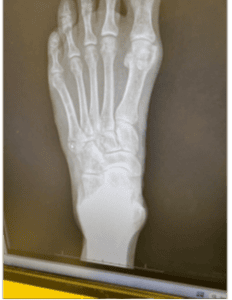
I broke my foot attending my first semester at the Institute, summer of 2025. I could’ve seen this as a sign that maybe I shouldn’t be there, but I chose to see it symbolically. In Man and His Symbols Jung (1968) wrote, “The sign is always less than the concept it represents, while a symbol always stands for something more than its obvious and immediate meaning. Symbols moreover are natural and spontaneous products”. Symbols can show up in a multitude of ways. The meaning can take time to reveal itself and must resonate with the receiver of the symbol. “Symbols, like dreams, are natural products, but they do not occur only in dreams. They can appear in any number of psychic manifestations: there are symbolic thoughts and feelings, symbolic acts and situations, and it often looks as if not only the unconscious but even inanimate objects were concurring in the arrangement of symbolic patterns” (Jung 1950, CW 18, para 480). My broken left foot was a spontaneous, psychic occurrence from the unconscious as a way to connect my inner life and outer world, which provided an opportunity for healing and growth. Our unconscious lives become more accessible through understanding symbols and carry significant importance for our individuation journeys. Within the symbol that chose me themes involving foundation, footing, loss of footing, and standpoint showed up.
Foundation: Our feet are our foundation, both physically and symbolically. With respect to somatic experience, our physical relationship to our feet can influence symbolically whether our feet are firmly planted on the ground or how sure-footed we feel. In the Iyengar yoga tradition, the physical standing postures or asanas require significant awareness in the feet. In the posture Tadasana or Mountain Pose, the first standing pose from which all other standing poses arise, steadiness of body requires specific alignment and attention to many details. Jung’s interest in Eastern religion brought him to India and yoga practice. On his trip to India, he noted how people in Indian culture seemed more embodied compared to the west. He wrote, “Life in India has not yet withdrawn into a capsule of the head. It is still the whole body that lives…When you walk with naked feet, how can you ever forget the earth” (Jung 1964, CW 10, para 988). To stay grounded symbolizes a standpoint from which one can move, where the physical action of the feet as well as the image of feet are inherent in what it means to be grounded.
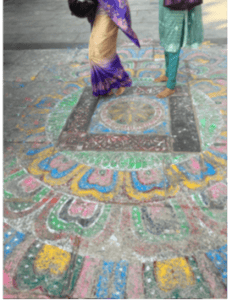
After my 50th birthday, I decided to make a pilgrimage to India given my years of practice in the Iyengar yoga tradition. With the guidance of a Jungian analyst, Dr. Ashok Bedi, we visited the temples of Shiva, the Hindu deity of destruction who dismantles the universe to allow for its rebirth. Upon entering the temples, shoes were not allowed. Removing shoes and being barefoot is a symbolic gesture of reverence and humility. It can also symbolize leaving the outer world and entering into inner, sacred space as in the Japanese custom of removing shoes before entering one’s home or before entering a yoga studio or dojo to practice an ancient art form. As I walked with bare feet upon the stone surfaces throughout the ancient grounds along with hundreds of others to pay respect to the wisdom of Shiva, this act of reverence became more embodied. At some point the black bottoms of my feet did not matter. The deeper connection to the warm and dusty stones of the temple grounds opened channels of receptivity. The many spiritual practices, where bare feet represent humility and spiritual devotion, is an embodiment of what can feel sacred and holy, the connection to earth ever-present.
Footing (Independence and Movement): Going to the Institute and starting analytical training was an archetypal pilgrimage that would be full of challenges and obstacles along the way. “Emblematic of one’s material being, feet can also suggest the sequenced movement along a spiritual path, sacralized in the pilgrimages of all the great religions”, (ARAS, p. 424). Making a pilgrimage involves the feet as people have walked miles to holy places throughout history as well as making a symbolic pilgrimage to a destination involving air travel. In my case, going to the original training Institute where Toni Wolff started the psychology club in 1916 was not only a pilgrimage, but an act of following in the footsteps of both my analysts who had trained in Zurich. The idiom following in the footsteps of someone can symbolize an act of great respect by doing what someone else has done. Their examples allowed me to take a step toward my professional development and individuation way beyond the familial and societal limitations I was born into; the analysts I respected made the possibility of analytical training a reality and something attainable. That both my analysts had trained at the Institute gave me a foothold that provided a sense of security for me in pursuing this endeavor.
Independence is a common theme in foot symbolism as well, as in standing on your own two feet. In Letters to a Young Poet Rilke wrote in 1903, “It is good that you are about to enter a profession that will make you self-sufficient and set you on your own feet…But in the midst of these very unfamiliar conditions your inner solitude will be a support and home to you. It will be the starting point of all your journeys”. Psychologically it’s not easy to stand on one’s own feet. Today we see younger generations more and more anxious looking out onto a world that seemingly has no future. In the midst of a crumbling foundation on which to stand, the polycrisis of our times makes standing on your own two feet more challenging than it already can be under the best of circumstances. Jung wrote, “Unless he (the individual) stands firmly on his own feet, the so-called objective values profit him nothing, since they only serve as a substitute for character and so help to suppress his individuality” (Jung 1964, CW 10, para 535). As psychotherapists and analysts, helping people individuate in their own lives is more important than ever to navigate and move forward into this futureless world where the foundation is no longer strong. As Rilke said in 1914, “What more can we accomplish now than the survival of the soul…So much in collapse, so much seeking new ways out”.
Loss of Footing (Vulnerability and Mistakes): When we lose our footing, we typically don’t feel grounded and that’s when accidents can happen. Philemon, Jung’s inner guide, had a lame foot. This immobility helped Jung to not lose his footing during his confrontation with the unconscious. There are many psychological ways the ground becomes unstable, and we lose our footing in life. Most of life’s milestones and transitions begin with endings and end with new beginnings; times where we might feel ungrounded and temporarily lose our footing. Stepping into these threshold places can pull the carpet out from under our feet as we are thrust into unknown territory. Jung talked much about his loss of footing in the chapter Confrontation with the Unconscious in his autobiography, Memories, Dreams, Reflections (MDR 1961). After he parted with Freud he said, “I felt totally suspended in mid-air, for I had not yet found my own footing”. Here he steps away from Freud, someone who has been a father figure and mentor, to be true to his ideas and understanding that no longer align with Freud’s theories. Taking a step like this is always vulnerable. With profound change and loss, Jung makes choices to dive into the depths of his unconscious. He said, “I let myself drop. Suddenly it was as though the ground literally gave way beneath my feet, and I plunged into dark depths (MDR 1961)”. Psychological loss of footing makes us vulnerable where mistakes and mishaps can occur.
That fairy tales and myths provide symbolic material which serves us on our path of individuation, it’s important to note that my broken foot happened while walking through the forest. Entering into the forest is symbolic of entering into the unconscious where we encounter the unknown, wild, and mysterious aspects of the psyche. This journey into the inner wilderness is essential for the process of individuation, the lifelong quest for psychological wholeness and self-realization where what’s unconscious comes more into consciousness. My foot rolled as if out of nowhere given I tripped on nothing and did not lose my balance. In the throes of an inner complex, I lost my footing on groundless ground; I had lost my standpoint.
Standpoint: In The Book of Symbols (2010) it’s written, “A reliable, practical person has her feet planted firmly on the ground. One perceives and acts according to one’s standpoint; a capable person is sure-footed, one who thinks methodically proceeds step-by-step” (p.424). To lose one’s standpoint might be necessary in order to heal and grow, hence become more individuated. As I heard in a recent lecture, “Just when we think we’ve got it right, the unconscious can strike back” (J. M. Gossett 2026). There is no end to our individuation journey. In his break with Frued Jung wrote, “I had known that everything was at stake and that I had to take a stand for my convictions” (MDR 1961). To find one’s footing and regain one’s standpoint after the choice to be true to self takes time, patience, and courage. Breaking my foot was part of my initiation into the Institute. Initiations are individual experiences where particular trials are needed for one’s personal growth and transformation. In the forest one can get lost, encounter beings both helpful and malevolent, and face all manner of challenges. How one fares determines her success or failure in coming to terms with something still unconscious; this alchemical transformation of an aspect of character or energy leads to greater wholeness. Losing our grounding and footing in life can wake us up to greater consciousness so we can stand on the earth from a new vantage point. Regaining ones’ footing and stepping into a new standpoint where shadow parts can become more integrated is what happens when the known foundation no longer holds up, the old movements and vulnerabilities need reworking, and loss of footing leads to a more integrated standpoint from which to move forward into a life of service to the soul.
JPA members can contribute to the conversation. Learn about membership.